There's a phrase that entered the startup vocabulary around 2015 and has quietly dominated consumer-facing brand decisions for a decade: the minimum viable brand. The idea was pragmatic. In the early stages of a startup, the brand work you do is probably wrong, because you don't yet know what the company is. The rational move is to ship the cheapest identity that won't actively hurt, use it to test the product, and invest in real brand work only after product-market fit.
This logic produced a generation of SaaS startups that all look the same: a Geist or Inter wordmark, a single saturated accent color, a minimalist illustration pack, maybe a Squarespace-era landing page. The minimum viable brand worked when it was a competitive differentiator — when most startups shipped terrible Bootstrap websites with their logo in Comic Sans, a tasteful minimal brand was a signal of serious craft.
That era is over. The minimum viable brand is no longer minimally viable. Here's why, and what's replacing it.
The Saturation Problem
When every Series A startup ships a near-identical brand system, the signal that brand system was sending — "we're serious, we have taste" — is gone. A monospace logo on a black-and-violet marketing site in 2016 communicated discernment. The same system in 2026 communicates "we hired a designer off a template marketplace."
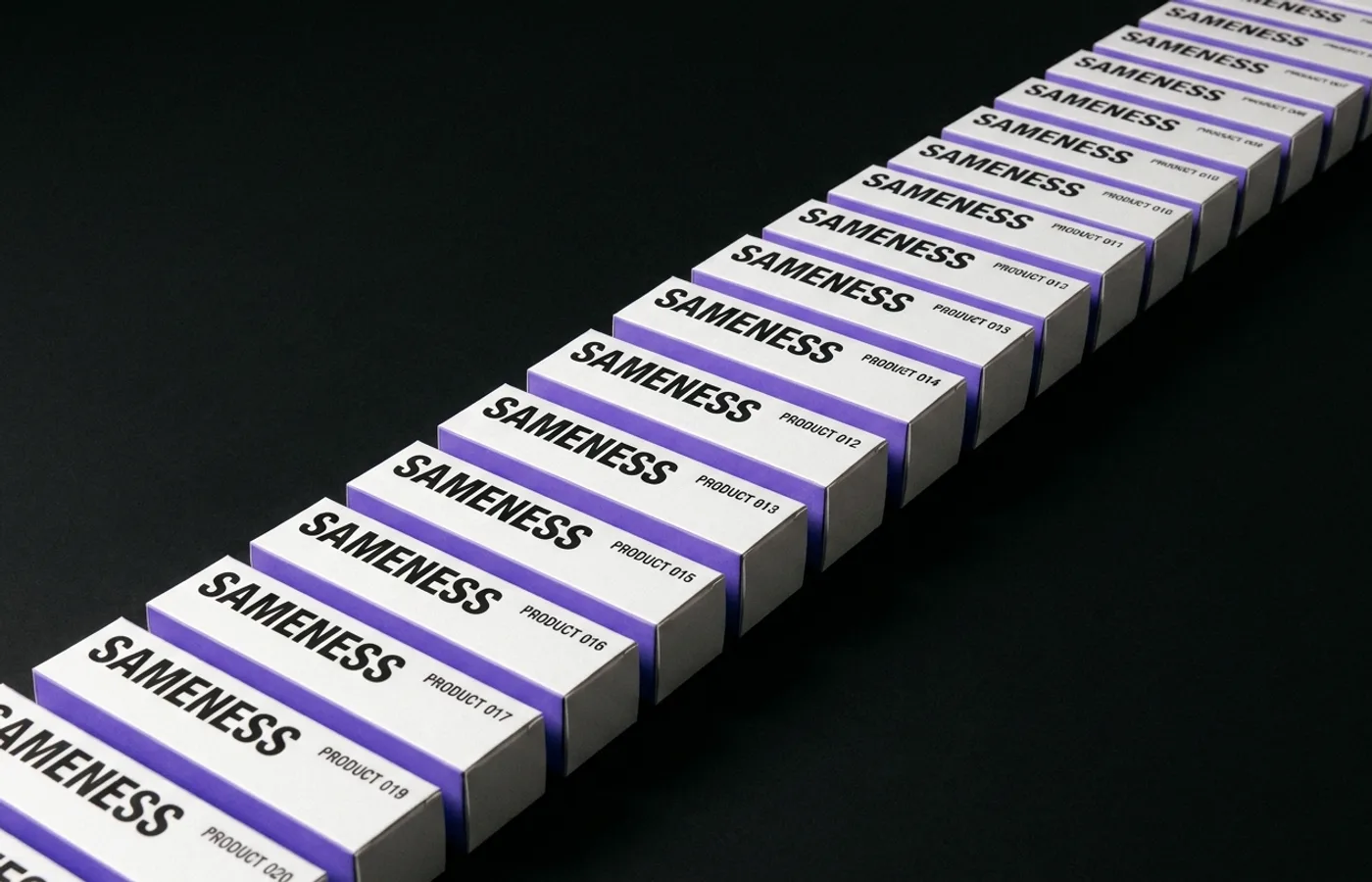
The category's visual consensus has converged so tightly that a consumer — even a sophisticated one — has no way to distinguish between twenty startups competing for the same budget. The brand stops doing the thing it was hired to do: make this startup distinguishable from that one.

This is not a subjective aesthetic complaint. It's a measurable problem in paid-acquisition performance. Conversion rates on landing pages in saturated categories have declined steadily over the past three years as brand differentiation has compressed. The minimum viable brand is becoming a minimum viable cost, not a minimum viable asset.
What's Replacing It
Three moves define the brands making meaningful differentiation in 2026.
Commission a real symbol at seed stage, not Series B. The conventional wisdom was that symbol investment — a mark, not a wordmark — was a luxury good reserved for post-revenue companies. That wisdom was backwards. A symbol gets stronger with every exposure, and a seed-stage company gets more exposure in its first two years than in years three through five. Commissioning a symbol at seed lets the accumulated exposure do the compounding work. Stripe's original design system predates their scale. Airbnb's Bélo predates profitability. The companies that waited to invest at Series B have weaker marks because the early exposure was spent on a temporary placeholder.
Invest in a proprietary typographic voice. The opposite of the Inter-tight-grotesque default is commissioning a custom type family — or licensing a distinctive one — early. Wise (formerly TransferWise) commissioned Wise Sans. Gumroad uses Caslon Doric. Stripe uses Sohne. These choices cost money but create an immediate sonic signature that no competitor using the free-tier font can match. In 2016 this looked like overspending. In 2026 it's the baseline for a brand that wants to be recognizable.
Treat photography as a first-class brand asset. The generic stock-photography-plus-geometric-illustration default is dying. Brands that invest in a proprietary photographic language — specific photographers, specific treatment, specific subject vocabulary — differentiate at a perceptual level that logo work cannot. Arc Browser's warm domestic photography, Resend's magazine-editorial imagery, Clerk's real-people portraits. These are the brand assets that make a visit to the site memorable.
The Investment Logic Has Reversed
The minimum viable brand argument rested on a premise that was true for a while: brand investment compounds slowly, product investment compounds quickly, so invest in product first and brand later. That premise is no longer right.
Brand investment in a saturated category now compounds faster than incremental product investment, because product differentiation in commoditized categories has a lower ceiling than brand differentiation does. A better CRM is marginally better; a dramatically better-designed CRM is perceptually a different category. Rippling, Brex, Ramp, Deel all sell similar products, and the one with the distinctively-designed brand has a compounding trust advantage that a 12% better feature set cannot match.
The founders making this calculation in 2026 are the ones outperforming on retention and paid conversion. The founders still optimizing the minimum viable brand are getting beaten in their markets by teams that shipped identity that looked expensive at seed stage because the investment earned its money back through distinctiveness.
What To Do
If you're at pre-seed, commission a symbol — not a wordmark refinement, a real symbol. Expect to pay $40–80K for serious studio work. Expect the mark to look wrong for the first year and right for the next ten.
If you're at seed, commission a typographic voice. License Sohne, Sangbleu, or commission a custom workhorse from a serious foundry. The license will cost less than a month of engineering salary and will compound across every surface for a decade.
If you're at Series A, commission a photographic language. Hire a specific photographer. Produce 50 original images with a consistent treatment. Rotate them through every surface for a year. Then do it again.
If you're doing none of these and still using the 2018 minimum-viable-brand default, your brand is already losing. The market has moved. The minimum viable brand is dying, and it will be good for everyone when it finishes dying, because what replaces it is a category of brand work that actually does the job of brand work.