How Copenhagen Became the World's Most Design-Literate City
You notice it before you consciously register it. The bike lane isn't just painted onto the road: it's a physically separated surface, slightly elevated, with its own traffic signals designed in a typeface that matches the city's wayfinding system. The bench at the bus stop isn't municipal afterthought; it's a Hay collaboration with the city, the same Danish design house whose furniture fills Soho apartments at ten times the price. The harbor bath where teenagers swim in June is a wooden-decked parallelogram cantilevered over the canal, designed by JDS Architects with the kind of attention to material and form that most cities reserve for concert halls.
Copenhagen doesn't just produce good design. It has built an entire civic infrastructure around design literacy, a city where the gap between the designed object in the gallery and the designed object on the street has been deliberately, systematically closed.
UNESCO named Copenhagen its World Capital of Architecture for 2023, a title awarded every three years that the city holds until the next congress that surprised no one who had walked its streets with open eyes. But the title captures only part of the story. Architecture is the visible layer. Underneath it runs something more unusual: a public policy ecosystem that treats design not as decoration but as civic methodology.
The Institutional Backbone
Copenhagen's design culture didn't emerge from the market. It was built by institutions.
The Danish Design Centre, a government-funded organization operating since 1978, functions as a bridge between design thinking and public policy. Its programs don't just support designers: they embed design methods into municipal decision-making, from hospital planning to immigration services. When the City of Copenhagen redesigned its citizen contact center in 2019, DDC facilitated the process, applying service design methodologies that most private-sector firms would charge six figures to deploy.
KADK, the Royal Danish Academy, sits at the center of this ecosystem. Its architecture and design programs have trained generations of practitioners who move fluidly between commercial practice and public service. The school's physical campus in the Holmen naval base area is itself a statement: repurposed industrial architecture that embodies the Danish principle that good design improves what already exists rather than replacing it.
Then there's Designmuseum Danmark, housed in a former Rococo hospital on Bredgade. The museum's permanent collection spans 500 years of Danish and international design, but its relevance to Copenhagen's design literacy lies in its rotating exhibitions and public programming. It treats design history as living knowledge, not archival curiosity. A 2025 exhibition on Nordic wayfinding systems drew connections between Viking navigation markers and contemporary transit design: the kind of intellectual ambition that positions design as cultural infrastructure rather than creative industry.
These three institutions (the policy arm, the academy, the museum) form a triangle that no other city replicates at the same scale. Tokyo has individual design museums that rival or exceed Designmuseum Danmark. Milan has design schools with comparable prestige. But Copenhagen connects all three into a system where education feeds practice, practice informs policy, and policy funds education.
Jan Gehl and the Pedestrian-First Philosophy
No discussion of Copenhagen's design culture is complete without Jan Gehl, the architect and urbanist whose work transformed not just his home city but the global conversation about how cities should be designed for people.
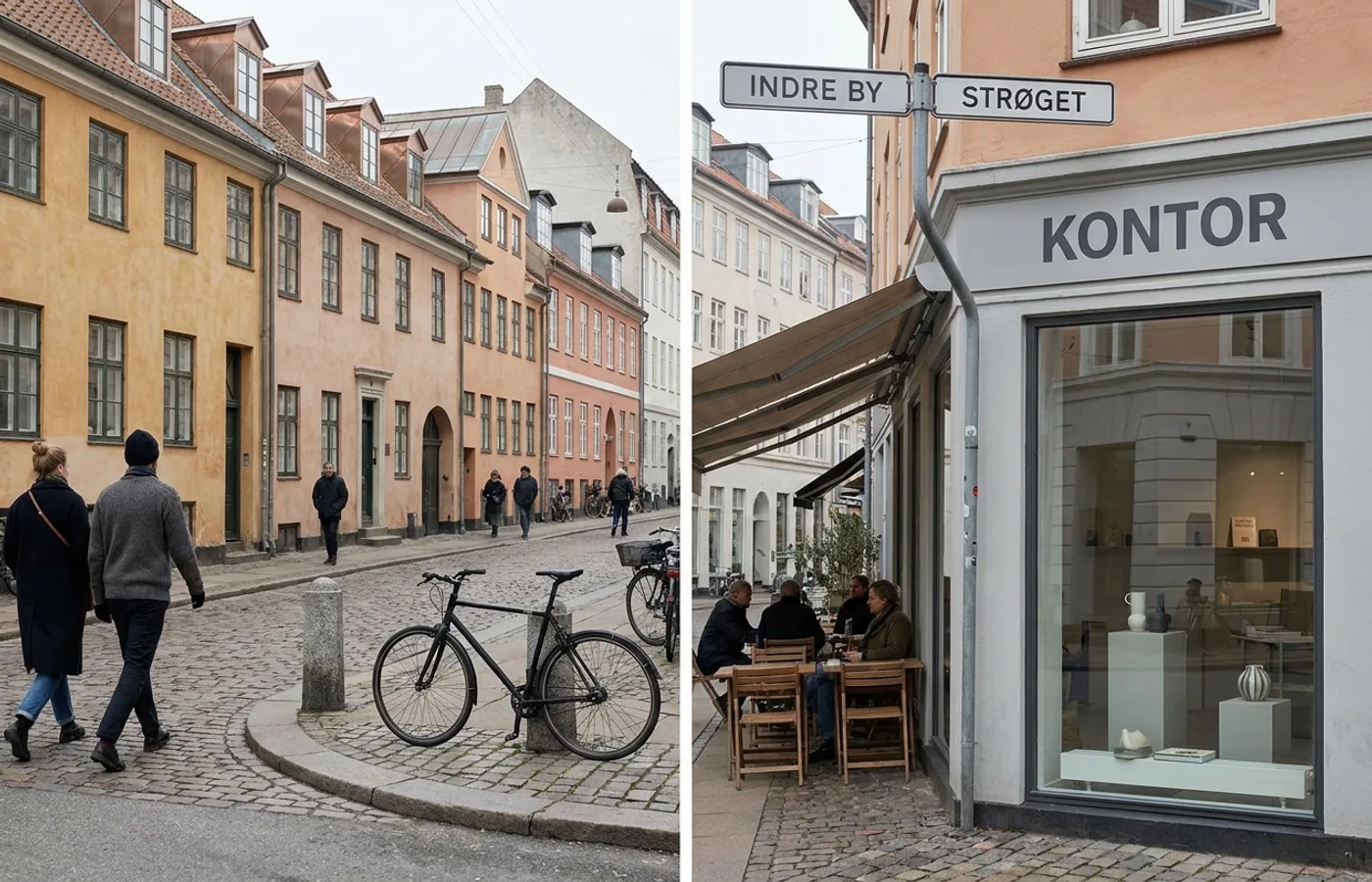
Gehl's central argument (that urban design should begin with human behavior, not vehicular traffic) sounds unremarkable now. In the 1960s, when he began studying how Copenhageners used Strøget, the city's main shopping street, it was considered radical. His methodology was disarmingly simple: sit in a public space and count what people do. How many walk? How many linger? Where do they sit? What makes them stop?
The data told a story that planners didn't want to hear. Cars made streets worse for everyone, including drivers. Pedestrians, cyclists, and public life created economic and social value that car infrastructure destroyed. Copenhagen, to its credit, listened.
The pedestrianization of Strøget in 1962, over fierce opposition from shop owners who predicted economic ruin, became the proof of concept. Shop revenues increased. Foot traffic multiplied. The street became a model studied by urban planners worldwide. Gehl Architects, the studio Jan Gehl later founded, went on to advise New York, Melbourne, Moscow, and dozens of other cities on public space strategy. But Copenhagen remained the laboratory.
Today, the Gehl legacy is visible in every Copenhagen design decision that prioritizes human scale. The Cykelslangen (a sinuous, elevated bicycle bridge designed by Dissing+Weitling that snakes through the harbor area) exists because the city's cycling infrastructure isn't an add-on. It's the primary transportation network, carrying 49% of all commuter trips. The Nørreport Station redesign by COBE Architects stripped away a chaotic above-ground bus terminal and replaced it with a public plaza whose granite surface, integrated bike parking, and pedestrian flows were studied and optimized using Gehl's behavioral observation methods.
The design thinking here isn't aesthetic. It's methodological. Copenhagen doesn't make pretty public spaces: it engineers them around evidence of how people actually live.
The Studio Ecosystem
Copenhagen's design influence extends well beyond urban planning. The city is home to a concentration of brand, type, and communication design studios whose work shapes global visual culture.
Kontrapunkt, founded in 1991, has built a practice that bridges Scandinavian design sensibility with corporate brand strategy at international scale. Their work for the Copenhagen Metro, a wayfinding and visual identity system that turns a transit network into a cohesive design experience, is a masterclass in public-sector design that respects both functional requirements and aesthetic ambition. Their rebrand of Scandinavian Airlines (SAS) demonstrated that a legacy carrier could modernize its identity without abandoning the restrained, confident typography that defines Nordic visual language.
e-Types, meanwhile, has become one of Europe's most respected type foundries while maintaining a brand design practice that refuses to separate typography from identity. Their custom typefaces for Danish institutions and international brands treat type as the structural material of brand systems, not a decorative layer applied after the strategy is set. It's an approach that reflects Copenhagen's broader design philosophy: function and form are the same conversation.
Homework, a smaller studio founded by Jack Dahl, represents the newer generation, studios that grew up in Copenhagen's design ecosystem and now export its values globally. Their work is characterized by the kind of typographic confidence and material restraint that international clients associate with "Scandinavian design" but that Homework delivers with conceptual rigor rather than stylistic formula.
What connects these studios isn't a shared aesthetic: Kontrapunkt's corporate precision is worlds apart from Homework's editorial experimentation. What connects them is a shared assumption that design is a serious intellectual discipline, not a service layer on top of business decisions. That assumption comes from growing up in a city where design is woven into public life.
Superkilen: Design as Civic Dialogue
If Copenhagen's institutional backbone represents design-as-policy from above, Superkilen represents something rarer: design-as-negotiation from below.
The park, completed in 2012 in the Nørrebro district, emerged from one of the most ambitious collaborative briefs in recent European public space design. BIG (Bjarke Ingels Group) led the architecture. Topotek 1, the Berlin-based landscape firm, handled the surface and planting strategy. Superflex, the Danish art collective known for projects that blur the line between social intervention and aesthetic production, drove the conceptual framework. The three-way collaboration was deliberate: no single discipline would dominate the outcome.
The premise was radical in its simplicity. Nørrebro is one of Denmark's most ethnically diverse neighborhoods, home to residents from over 60 nationalities. Rather than imposing a unified Scandinavian design language onto that diversity, the team invited residents to nominate objects from their countries of origin, objects that carried personal or cultural meaning. The result is a public space populated by a Moroccan fountain, a Thai boxing ring, a set of barbecue grills from Argentina, a sound system from Jamaica, manhole covers from Zanzibar, a slide modeled after a Soviet-era playground structure, and dozens of other artifacts sourced, imported, and installed across the park's three color-coded zones: the Red Square, the Black Market, and the Green Park.
The design logic is neither nostalgic nor tokenistic. Each object was selected through community workshops and then integrated into a landscape architecture that treats the entire 30,000-square-meter site as a continuous graphic surface. The Red Square's saturated ground plane, an undulating terrain of pink and orange rubber, transforms everyday urban furniture into something confrontational and joyful simultaneously. The Black Market uses a monochrome asphalt surface studded with white lines to create an almost op-art terrain where the collected objects feel like exhibits in an open-air museum of global everyday life.
What makes Superkilen significant beyond its visual spectacle is the design methodology it represents. Copenhagen didn't commission a park and then consult the community as an afterthought. The community's material culture became the literal content of the design. It is participatory design at the level of physical infrastructure: not a survey, not a focus group, but 108 objects from 60 countries embedded permanently into the city's surface.
The project also pushed its collaborators into unfamiliar territory. BIG, known for diagrammatic architecture at ambitious scale, had to subordinate formal gestures to a curatorial logic driven by community input. Superflex, whose practice typically operates in galleries and biennials, had to produce work that would withstand daily use by skateboarders, dog walkers, and families. The collaboration itself modeled the cross-disciplinary exchange that Copenhagen's design ecosystem makes possible.
Critics have noted the tension: the park aestheticizes diversity in a neighborhood facing real gentrification pressures. That critique is valid and worth holding. But as a model of what inclusive public design can look like when it goes beyond accessible ramps and multilingual signage (when it asks whose objects, whose references, whose daily life a public space should reflect) Superkilen remains one of the most instructive projects of the twenty-first century. It is Copenhagen's design culture operating at its most ambitious: not just designing for the public, but designing with them.
The New Nordic Design Language
Copenhagen's design culture is inseparable from the broader New Nordic movement that has reshaped Denmark's cultural exports over the past two decades.
The movement began in food: Noma, René Redzepi, the manifesto that Nordic cuisine should express its own terroir rather than imitating French or Italian traditions. But the underlying principle (that excellence comes from working with local materials, constraints, and values rather than importing global formulas) migrated quickly into fashion (Ganni, Stine Goya), furniture (Hay, Muuto, &Tradition), and design.
In brand and visual design, New Nordic translates to a specific set of values: restraint over embellishment, materiality over glossiness, function integrated with aesthetics rather than competing against it. Copenhagen's contribution to global brand trends: the preference for muted, natural palettes; the revival of humanist typefaces; the emphasis on physical materials and tactile experience even in digital contexts: flows directly from this sensibility.
The influence is visible far beyond Scandinavia. When a London fintech brand chooses a restrained sans-serif and an earth-toned palette, or when a New York DTC brand photographs its products against raw linen rather than seamless white, the design DNA traces back through a chain of influence that runs through Copenhagen.
The specifics are traceable. Cereal magazine, the Bristol-based travel and culture publication that helped define the visual language of millennial lifestyle branding, drew openly on Danish editorial design traditions: generous white space, restrained typographic hierarchies, photography that privileges atmosphere over information. Aesop's retail environments, designed with an obsessive attention to material honesty and spatial restraint, echo principles codified in Danish furniture and interior design decades earlier. Even Apple's post-Jony Ive design direction (the return to warmer materials, softer radii, and interfaces that feel less surgical) reflects a broader industry pivot toward values that Copenhagen-trained designers have long treated as baseline.
In brand identity specifically, the Copenhagen influence shows up as structural philosophy, not surface style. The preference for flexible design systems over rigid logo-centric identities; the insistence that typography can carry a brand without relying on graphic ornament; the treatment of negative space as an active design element rather than empty real estate: these principles, now standard in sophisticated brand work from London to Seoul, were practiced as default methodology in Copenhagen studios long before they became global best practice.
The city didn't just develop a design language. It exported a set of values about what "good" looks like, and the global design industry bought in.
The Tension: Can Design-Centrism Survive Its Own Success?
Copenhagen's design culture faces a paradox familiar to any city that has successfully branded itself around livability: success attracts capital, capital drives up costs, and rising costs push out the creative community that made the city attractive in the first place.
Nørrebro, the multicultural neighborhood where Superkilen park stands (a project by BIG, Topotek 1, and Superflex that placed objects from 60 nationalities into a single public space) is now one of Copenhagen's fastest-gentrifying areas. The park itself, a celebrated piece of inclusive design, sits in a neighborhood whose diversity is under pressure from the real estate market that the design helped heat up.
There's a deeper tension, too. Copenhagen's design culture was built on public investment, institutional patience, and a social-democratic commitment to design as a public good. As the city increasingly markets itself as a global design destination, competing for talent and tourism with the same branding language it helped invent, there's a risk that design-as-civic-methodology becomes design-as-city-marketing. The former produces Nørreport Station. The latter produces Instagram-optimized architecture.
The best evidence that Copenhagen's design culture has real depth, not just surface appeal, is its institutional infrastructure. Trends fade. Funding models persist. As long as the Danish Design Centre is embedding designers into government processes, KADK is training practitioners who see public service as a legitimate career path, and the city's cycling infrastructure continues to expand based on behavioral data rather than political convenience, Copenhagen's design literacy is structural, not cosmetic.
That's the lesson other cities keep missing. They visit Copenhagen, admire the bike lanes and the harbor baths, and go home to commission a waterfront development. What they should be studying is the system: the policy, the institutions, the cultural assumption that design is how a city thinks, not how it decorates.
Copenhagen doesn't need to call itself a design city. The evidence is in the surface of every bike lane, the angle of every bench, the typography on every transit sign. It's a city that decided, decades ago, that design is a form of civic intelligence, and then built the institutions to prove it.
For designers, the takeaway isn't to move to Copenhagen. It's to study how design thinking, when embedded in public infrastructure rather than confined to studios and portfolios, changes what a city can be. Tokyo mastered the art of wayfinding as a design system. Copenhagen mastered something broader: design as a way of governing.
Sources and data notes
Copenhagen named UNESCO-UIA World Capital of Architecture for 2023, UNESCO, https://www.unesco.org/en/articles/copenhagen-named-unesco-uia-world-capital-architecture-2023, retrieved 2026-09-04. The title is awarded every three years and is held until the following congress.
The Danish Design Centre has operated since 1978; Stroget was pedestrianised in 1962; Superkilen was completed in 2012 by BIG, Topotek 1 and Superflex.
The 2019 citizen contact centre project and the 2025 wayfinding exhibition are described from institutional programme materials and have not been independently verified.