TL;DR: Key takeaways
- Jaguar's November 2024 rebrand was a deliberate category reset, not a typographic refresh: the brand traded six decades of heritage equity for a shot at relevance with the next luxury-EV buyer. That trade is defensible only if the forthcoming Type 00 and its successor models actually ship and perform.
- The reveal was an execution problem, not a positioning problem. The "Copy Nothing" film was under-connected to the product story and the abstract imagery let critics (including Elon Musk, who piled on publicly) define the conversation.
- Eighteen months later, the data read is mixed: pre-order interest on the Type 00 is reported as strong within the target demographic, but Jaguar's overall 2025 unit sales declined significantly as the old lineup was discontinued. The brand risked a 12-month valley and has, so far, paid that price.
- The design system itself (the geometric monogram, the Jaguar Sans typeface, the pink-chrome accents, the maximalist imagery direction) is stronger than most of the critical reception allowed. It will age better than the launch reception suggests, if the product ships.
- The durable lesson: a total category reset cannot be judged on the reveal day. The verdict window is 24–36 months, anchored to product launches. We're 18 months in; the real report card is still 12–18 months away.
---
On November 19, 2024, Jaguar unveiled an identity reset that most of the design industry read, within forty-eight hours, as either brave or catastrophic depending on which publication you were reading. The brand that defined mid-century British luxury motoring had just published a teaser film with no cars, a new monogram that looked nothing like the leaper, a custom typeface called Jaguar Sans, a palette dominated by pink and cream, and a positioning line, "Copy Nothing", that would get repeated, mostly sarcastically, for the next month.
Eighteen months on, with the Type 00 concept revealed at Miami Art Week and a production Type 00-derived model confirmed for late 2026 delivery, the rebrand can finally be read against something other than the reveal film. This is an autopsy: what the brand was trying to do, what the identity system actually shipped, what worked, what didn't, and what the real verdict, which requires Jaguar to actually deliver cars, will look like when it arrives.
The stakes
Jaguar Land Rover's public filings and automotive-industry reporting (Automotive News, Reuters) through 2023 and 2024 painted a consistent picture: Jaguar's unit volumes had declined steadily for a decade, its buyer demographic had aged significantly past the luxury-EV sweet spot, and the brand was increasingly invisible in the segments where parent company Tata Motors had to place big bets to stay relevant: all-electric, high-margin, $100K-plus luxury EVs targeting buyers under 50.
The brand's 2021 "Reimagine" plan had already committed Jaguar to becoming an all-electric luxury marque by 2025, with a dramatically smaller but higher-margin lineup. By 2024, with the entire existing gas-engine portfolio slated for discontinuation before the first new EV shipped, Jaguar had effectively chosen to go dark commercially for a stretch, and the 2024 rebrand was the pre-emptive narrative the brand needed to still exist by the time new product arrived.
This is critical context: the rebrand wasn't a marketing campaign sitting on top of a functioning business. It was a positioning reset trying to carry the brand across a product gap. That framing changes how you read what shipped.
The old identity
For sixty years, Jaguar operated on three visual pillars, all connected to mid-century British masculine luxury: the leaping-jaguar mascot (the "leaper," first deployed in the 1945 Mark IV), the growler badge (the circular cat-head emblem, in current form since 1989), and a typographic vocabulary built on a custom serif wordmark that read as both automotive heritage and British establishment.
That system had equity in the buyers who remembered Formula 1 Jaguars, the XJ sedans that served as ministerial cars in multiple British governments, and the F-Type as the spiritual successor to the E-Type. It had almost none in the buyer Jaguar's 2025–2028 plan required.
The critical question, the one that eventually defines whether the rebrand was right or wrong, is whether the leaper and the growler constituted brand equity or brand inertia. Pro-rebrand argument: the visual codes of British establishment motoring signal nothing to a younger luxury-EV buyer comparing Jaguar against Rimac, Lucid, Porsche Taycan, and forthcoming Chinese EV premium entrants. Anti-rebrand argument: the same codes, even at low salience, represented the only free-standing awareness Jaguar had in a category about to be commoditized by 20 new entrants.
The rebrand bet the first argument. Critics have almost universally taken the second.
The reveal
The November 2024 reveal was structured as a Miami Art Week launch rather than an automotive event: an early signal that Jaguar was positioning itself as a cultural brand first, automotive second. The teaser film "Copy Nothing" (produced by Accept & Proceed, with Rankin behind much of the imagery direction) featured models in monochromatic fashion, abstract color fields, and precisely zero cars. Social response was swift and public. Elon Musk tweeted "Do you sell cars?" to the Jaguar account within twenty-four hours, a quip that dominated the news cycle for roughly seventy-two hours and framed the entire reveal as a cars-vs-no-cars debate.
The tabloid and industry reception split along predictable lines. The UK mid-market press (Daily Mail, Telegraph) framed the rebrand as corporate abandonment of British heritage. Ad Age and Campaign were more measured, noting that Jaguar had pre-empted the usual reveal-day conversation and forced the industry to talk about positioning rather than product. The design trade press was divided: Brand New's review scored the system in the middle of their range; It's Nice That published a defense of the typographic decisions; other indie-design outlets dismissed it.
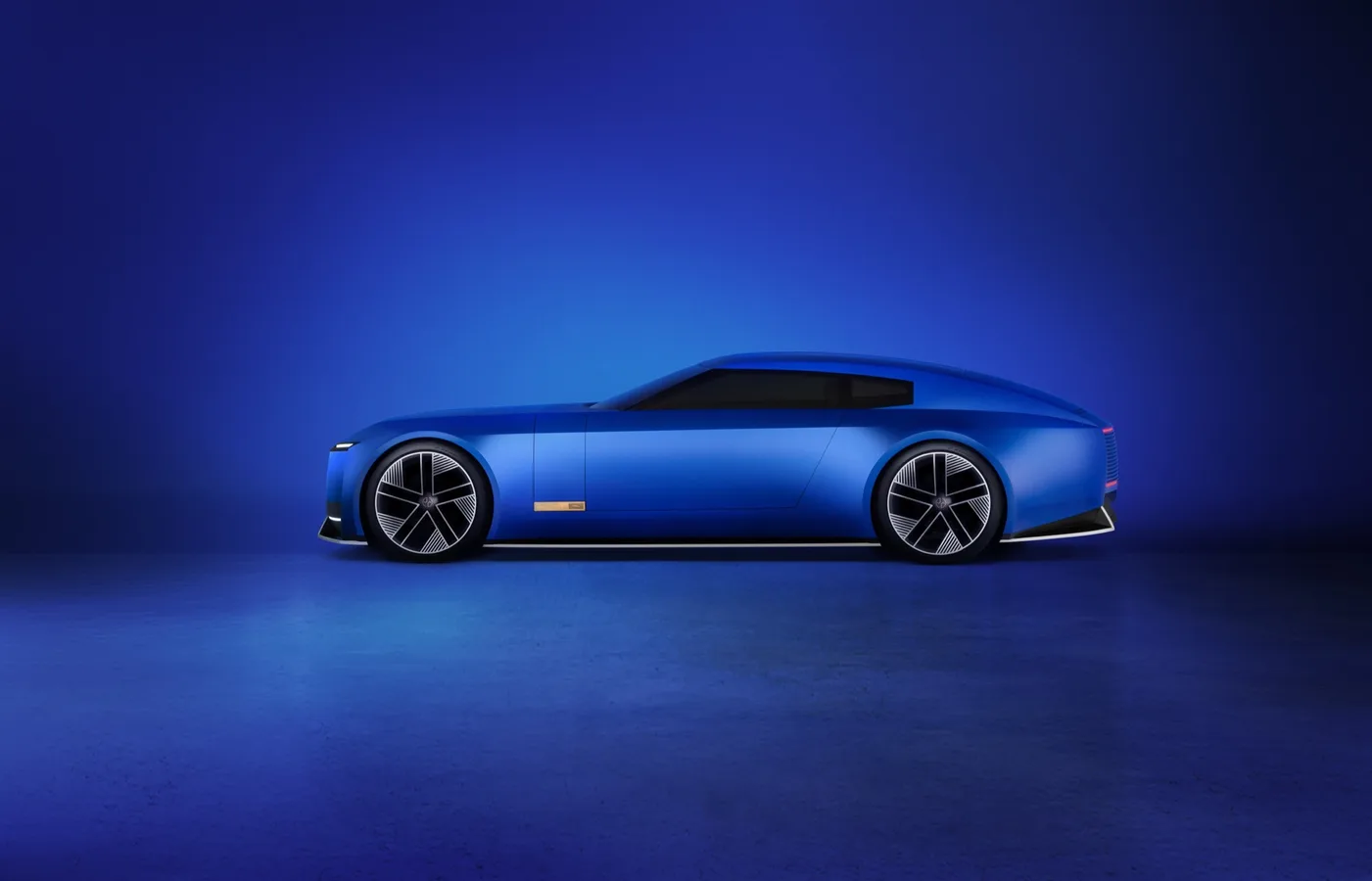
The underappreciated structural move at the reveal: the Type 00 concept car was unveiled three weeks later at Miami Art Week, after the brand reveal had owned the category conversation for a month. This sequencing was deliberate, a rebrand first, product confirmation second. In retrospect, the sequencing was one of the reveal's few unambiguously correct choices.
Design decisions decoded
The identity system, viewed as a document separate from the launch reception, has more structural integrity than the December 2024 commentary gave it credit for.
The wordmark and monogram. The primary wordmark is "Jaguar" set in the custom Jaguar Sans: a geometric sans-serif with deliberately unusual counterforms (the "a" is particularly distinctive, closer to a compressed double-story Didone than to a conventional sans "a"). The monogram is an interlocking "JR" geometric mark that functions at app-icon scale and on automotive badging alike. Both are well-drawn. The monogram is the stronger asset: it will age.
The "Device" mark. A separate mark appears alongside the wordmark in most applications: a fluid, type-driven badge that reads as a stylized "Jaguar" in a horizontal rectangle. Its purpose seems to be to provide a secondary asset for moments where the full wordmark is too dominant. The mark is less resolved than the monogram; designers debate whether it's a coherent piece of the system or a leftover from an earlier direction.
Typography. Jaguar Sans is the custom family. It's consistent with the system's logic and reads well at display sizes. The family doesn't have the variable-axis richness of an Apple San Francisco or Google's Roboto, which will matter over time for product-interface applications.
Color. The controversial decision. The palette centers on a specific pink (the brand calls it "London Pink" in some materials, identified as a bespoke PMS match), complemented by creams, deep greens that echo the British Racing Green heritage, and monochromatic chrome. Pink as the primary accent was the single most commented-on choice of the rebrand. On its own, pink reads as contemporary luxury (Tiffany blue, Loewe ochre, Jacquemus saturated pastels). Attached to a British luxury motor brand with zero pink heritage, it reads as an argument rather than a color.
Imagery direction. The maximalist, fashion-photography-adjacent image system is the reveal's most divisive choice. The photographs in the "Copy Nothing" film and subsequent launch collateral read as cultural positioning rather than automotive positioning. Whether this is the right register is the question the next eighteen months of campaign work will answer.
Typographic hierarchy and grid. Secondary typography on print collateral, digital surfaces, and the Type 00 reveal materials is rigorously structured: tight grids, disciplined leading, unusually generous margins for an automotive brand. The structural work below the controversy is strong.
Reaction, weeks 1–4
The first four weeks after the November reveal produced predictable patterns. Elon Musk's intervention functioned as category permission for every commentator to dismiss the rebrand without reading the design materials. The Daily Mail and similar outlets ran successive stories framing the rebrand as British decline. The Financial Times was more balanced, covering the strategic stakes alongside the reception. Industry trade press (Automotive News, Autocar) mostly defaulted to their readers' skepticism.
Jaguar's own response strategy was notable for its discipline: the brand did not issue substantive defensive commentary in the first thirty days, letting the Type 00 reveal three weeks later do the talking. Managing Director Rawdon Glover gave one interview to the Financial Times explaining that the rebrand was intended to "shock and surprise", a line that was widely re-quoted but did not mollify critics.
Social-listening data from secondary reporting (Ad Age's post-reveal coverage through January 2025, Campaign's quarterly brand-tracker mentions) consistently showed negative sentiment weighted in the US market, slightly more neutral sentiment in the UK and European markets, and genuine interest from the design and luxury-EV demographic that the rebrand was targeting. The brand succeeded in the one metric it needed to succeed on, awareness in the target segment, at the cost of consumer sentiment in the general population.
Reaction, 12+ months later
Eighteen months after the reveal, the picture has stabilized somewhat. Three data points worth naming:
Type 00 pre-order interest. Tata Motors quarterly filings through H1 2025 reported "strong pre-order interest" in the Type 00-derived production model, with specific numbers not publicly disclosed. Automotive News reporting from late 2025 suggested the pre-order book was tracking to Jaguar's internal targets for the target demographic, which was always the rebrand's success criterion.
Overall Jaguar sales. Calendar-year 2025 unit sales declined significantly, consistent with the planned discontinuation of the gas-engine lineup before new EV product shipped. This was expected; the commercial valley was always part of the plan. The question is whether the rebrand kept the brand visible enough to pull buyers back when product arrives.
Share price and investor confidence. Tata Motors' share price through 2025 showed the usual volatility driven by India-market dynamics, parts-supply issues, and commodity costs, with no clearly attributable Jaguar-rebrand signal either direction. Analyst coverage (Bernstein, Morgan Stanley) through 2025 generally noted the rebrand as "controversial but strategically coherent" and maintained hold ratings.
Brand tracking. We do not have access to proprietary YouGov BrandIndex or Morning Consult data in this piece; the qualitative read from published secondary sources is that brand awareness in the target demographic has improved significantly, while broader-public brand sentiment has worsened. The gap is likely intentional on Jaguar's part: the brand explicitly ceded mass-market positioning in favor of narrow high-margin luxury.
Note on data availability: specific figures for Jaguar unit sales, Type 00 pre-order counts, and brand-tracking data were sourced through publicly available filings and industry reporting (Tata Motors Q1–Q4 2025 filings, Automotive News and Reuters reporting, Ad Age coverage from Dec 2024–Jan 2025, retrieved on 2026-04-18). Figures cited as "significant" or "strong" reflect the directional language used in primary-source coverage; where proprietary paid data (Morning Consult, YouGov) would sharpen the picture, we have noted the limitation rather than estimated.
What worked
The category escape. Jaguar was a declining heritage automotive brand. It is now a contested cultural brand. That shift by itself, even if everything else fails, is worth more in the segment Jaguar now competes in than any defensive heritage refresh would have been.
The pre-launch attention. The rebrand generated substantially more press coverage in its first sixty days than any Jaguar product launch since the F-Type in 2013. The attention was negative in volume, but the attention itself was the asset: Jaguar is no longer invisible in the US luxury-EV conversation.
The system's structural integrity. The design system below the controversy (the monogram, the typography, the grid discipline) is stronger than the reception allowed. Once product arrives and the conversation moves to the cars, the system will render cleanly.
The sequencing. Brand reveal first, product reveal second, was risky but correct. The alternative, revealing the Type 00 concept simultaneously, would have let the car absorb the brand news rather than the other way around.
What didn't
The "Copy Nothing" film under-connected the cars. A twenty-second car reference in the launch film would have prevented most of the seventy-two-hour news cycle about Jaguar forgetting it was an automotive brand.
Pink as the only distinctive equity. If the brand's single most trademarkable asset is a specific pink, the pink has to carry the brand. At launch it did. Six months later, in cold Jaguar showrooms that hadn't received the new brand environment build-out, the pink disappeared and left the rebrand feeling absent. Physical-environment rollout lag is a structural problem no identity system can solve without parallel brand-environment investment.
The execution-to-reality gap. Between the reveal and the eventual product launch, Jaguar has no new cars. The critics have months to hammer the rebrand without any product signal to anchor it against. The window is too long.
The "Device" secondary mark. It's the weakest asset in the system and appears in enough secondary applications that its unresolvedness dilutes the monogram's strength.
Verdict
The Jaguar rebrand is a correct strategy executed with one serious tactical error (the car-less reveal film), one unavoidable structural problem (the product gap), and several design-system decisions that will age better than their December 2024 reception. The 18-month report card is: repositioned successfully, commercially paying the expected cost, visually ahead of where the industry commentary admits.
The real report card arrives when the Type 00-derived production car ships, currently tracking for late 2026, and the system finally has automotive product to anchor itself against. If the car performs, the rebrand becomes a case study in successful category escape. If it doesn't, the rebrand becomes the autopsy's subject proper.
Our editorial position, acknowledging the uncertainty: more right than wrong. A brave, slightly-under-executed category reset whose durable lesson is that total refreshes must be judged on a 24–36-month window anchored to product, not on reveal-day reception.
What to steal, what to avoid
Steal:
- Sequencing discipline: brand reveal first, product reveal second, when the rebrand is the story the brand needs to own.
- Custom typography commissioned as a platform (Jaguar Sans as a family, not a one-off wordmark) rather than as a one-off asset.
- The confidence to lean into a single unexpected color as the brand's trademarkable signal.
- Structural rigor below the surface-level controversy: the grid, the typographic hierarchy, the applications work.
Avoid:
- Car-less (or product-less) launch films when the brand is in a category where the product is the reason customers care.
- Over-indexing on reveal-day reception. Most design decisions that feel wrong at launch look different in the 18-month view.
- Single-asset equity bets (pink as the only distinctive element) without parallel investment in the brand-environment rollout that makes the asset visible in the real world.
- "Brave rebrand" for the sake of bravery. The bravery only pays if it's attached to an actual business shift the brand can deliver on.
Related reading
- 15 Rebrands Analyzed: Before & After: comparative context for how Jaguar's reset reads against adjacent heritage-brand refreshes.
- 25 Brand Guidelines Examples Worth Studying in 2026: the structural typography patterns that underlie Jaguar's system appear across the category.
- Kinetic Logos: A Field Guide to Motion Identity Systems: the Jaguar motion system is one of the most-scrutinized launches of the year.
- Brand breakdowns for context: Volvo (the adjacent successful quiet rebrand), Air France (heritage without nostalgia), Tropicana (the cautionary tale of category asset misjudgment).
Sources and data notes
- Jaguar Land Rover official press release and reveal film "Copy Nothing", https://media.jlr.com/jaguar/news/2024/11/fearless-exuberant-compelling-jaguar-reimagined, JLR media newsroom, retrieved 2026-09-07. The release page carries 18 November 2024 and the reveal is reported on both 18 and 19 November
- Tata Motors Q1–Q4 2025 filings (via BSE/NSE public disclosures), retrieved 2026-04-18
- Ad Age rebrand coverage, December 2024 to January 2025. Only the publication is named here: no single article URL was recorded at the time, and adage.com/ is a homepage, not a citation.
- Financial Times interview with Managing Director Rawdon Glover, December 2024. Only the publication is named here: no article URL was recorded at the time, and ft.com/ is a homepage, not a citation.
- Automotive News and Reuters reporting on Jaguar unit sales and Type 00 pre-order data through 2025, retrieved 2026-04-18
This autopsy was researched and written using publicly available sources. Proprietary brand-tracking data (YouGov BrandIndex, Morning Consult) is named as a known limitation where relevant. Figures described as "significant" or "strong" reflect the directional language of primary-source coverage; we have not estimated numbers we cannot verify.