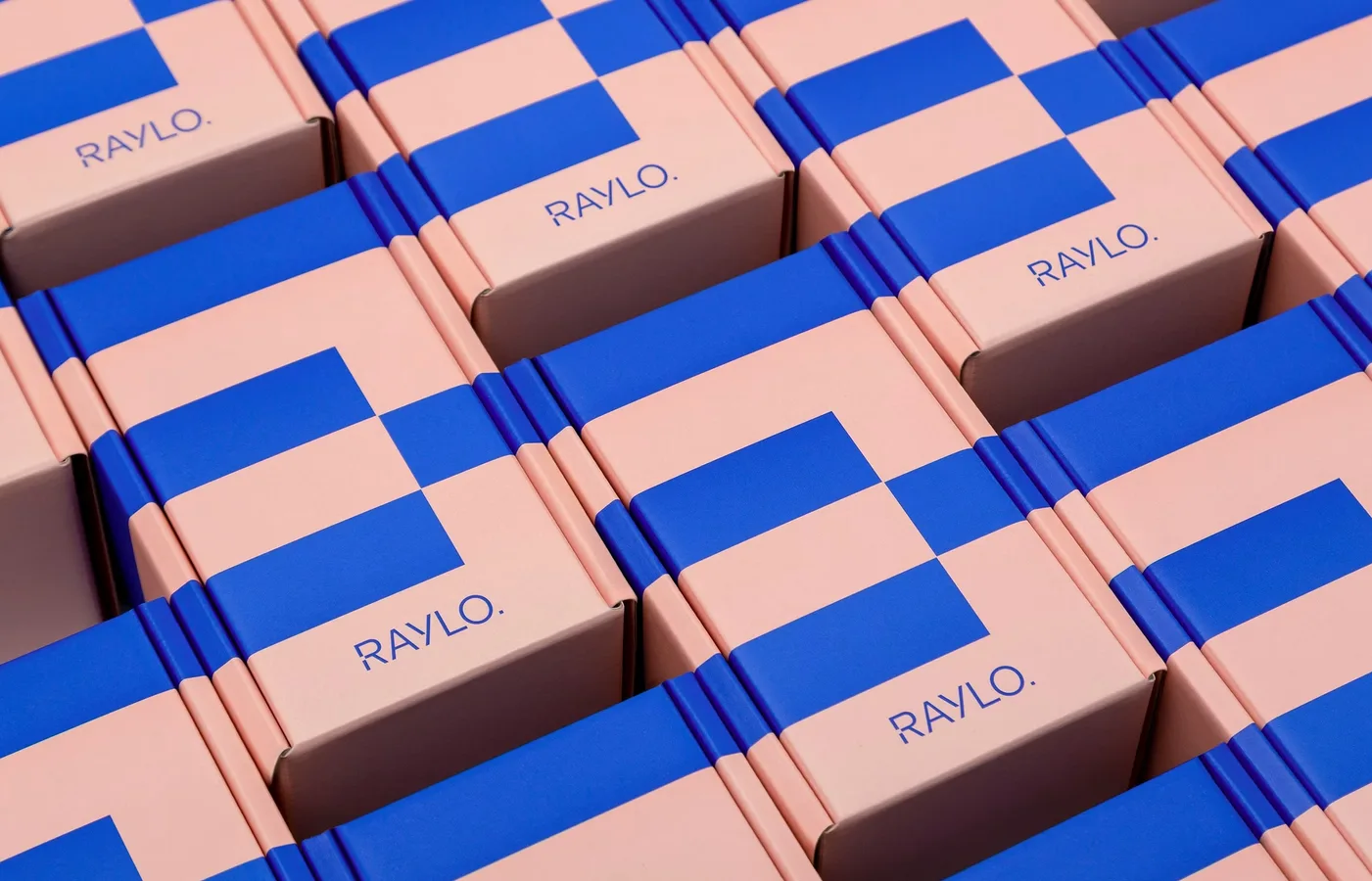
Raylo customers never own the phone they carry. They lease it, use it for two years, send it back, and it goes out again refurbished to somebody else. The model only works if people are comfortable holding something they have already agreed to hand on. Pentagram's London office built the identity around that condition instead of around recycling imagery.
The wordmark gives a piece of itself away
A square is cut out of the stem of the R. It is not discarded. It reappears at the end of the logotype as a full stop, so the letter gives something up and the word receives it. Pentagram calls the underlying device a switch, and it sits at the centre of the system rather than at its edges.
The switch shapes the icon set and gives the interface its feel, then scales up into a two-colour pattern. That pattern is not applied at one fixed intensity. On merchandise it stays pared back. On the packaging box and in the app loader it turns more expressive and more daring, which is how a single device covers a range of surfaces without flattening into wallpaper.
The palette skips the sustainability register entirely
Circular economy brands tend to reach for earth tones and a leaf. Raylo does not. Soft pink and pop blue carry the system, set against a charcoal that does the technical work and keeps the other two from turning saccharine. The three run across packaging, marketing collateral, the thank you card, the website, the phone case and the merchandise. Consistency at that spread is what stops a two-colour pattern from reading as decoration.
The typeface was altered by a single glyph
The system is set in FK Grotesk, chosen for typographic curves that pixelate on screen rather than smooth away. Pentagram made one change to it: the uppercase Y was swapped for the lowercase y glyph. The result, FK Grotesk Raylo, sits flush against the wordmark instead of merely next to it. One substitution is the whole customisation, and it is the kind of edit that only shows itself when the logotype and the running text share a line.
The proposition is what the identity had to solve
Raylo subscribers receive a SIM free device, fully insured, with a screen protector and a compostable Pela case made from plants rather than plastic. At the end of the two-year membership the phone goes back and the current model arrives. Old handsets stop accumulating in drawers, and the pricing undercuts the bundled contracts the large networks sell.